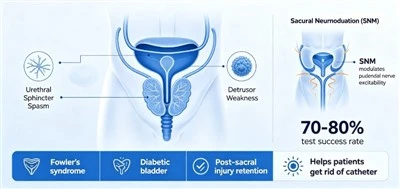
Permanent sacral neuromodulation (SNM) implantation is considered after a successful trial stimulation phase. Patients achieving at least 50% symptom improvement during Stage 1 may proceed to Stage 2 permanent SNM implantation following clinical assessment. This two-stage approach evaluates treatment response before a permanent implant is placed.
1. When Is Permanent SNM Implantation Recommended?
Permanent SNM implantation is considered for patients who demonstrate a meaningful response during temporary stimulation.
The treatment pathway includes two stages:
- Stage 1 – Trial Stimulation: A temporary stimulation system is used to evaluate changes in the patient's symptoms. The trial period is approximately two weeks, during which the patient records treatment responses.
- Stage 2 – Permanent SNM Implantation: Patients achieving at least 50% symptom improvement during the trial may proceed to permanent implantation following clinical assessment.
The trial results provide an important basis for deciding whether permanent implantation is appropriate. The final decision depends on the patient's medical condition and the treating team's evaluation.
2. How Is the Permanent SNM Implantation Procedure Performed?
Stage 2 replaces the temporary electrode arrangement with a permanent implanted system.
The procedure involves:
- Preparation: The clinical team reviews the trial results and confirms the permanent implantation plan.
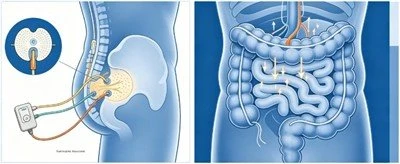
- Electrode Placement: The temporary electrode arrangement is replaced with a permanent electrode.
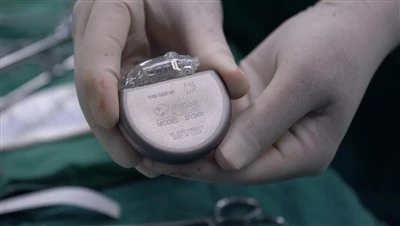
- Pulse Generator Implantation: The implantable pulse generator (IPG) is placed beneath the skin.
- Postoperative Observation: The patient receives postoperative assessment and instructions before discharge.
The published procedure information describes the use of local anesthesia (LA) and a minimally invasive surgical approach. The reported incision length is approximately 3–4 cm.
Patients can generally walk on the day of surgery, according to the published treatment information. Individual postoperative instructions depend on clinical assessment.
3. Permanent SNM Implant Device Options
Three IPG configurations are listed for the permanent SNM treatment pathway. They differ in battery type, expected battery life, weight, capacity, and charging requirements.
| Parameter | G132 | G131 | G134R |
|---|---|---|---|
| Battery type | Non-rechargeable | Non-rechargeable | Rechargeable |
| Expected battery life | 6–8 years | 8–11 years | 20+ years |
| Weight | 25 g | 35 g | 36 g |
| Battery capacity | 1850 mAh | 2500 mAh | N/A |
| Stimulation voltage | 0–10 V | 0–10 V | 0–10 V |
| Stimulation current | 0–25 mA | 0–25 mA | 0–25 mA |
| Charging | No routine charging | No routine charging | Wireless charging |
| Charging frequency | Not applicable | Not applicable | Approximately once every 2–3 months |
| MRI compatibility | 1.5T and 3.0T | 1.5T and 3.0T | 1.5T and 3.0T |
Differences Between the Available SNM Implant Device Configurations
G132 – Compact Non-Rechargeable Configuration
- 25 g weight.
- 1850 mAh capacity.
- Expected battery life of 6–8 years.
- No routine charging required.
G131 – Extended-Life Non-Rechargeable Configuration
- 35 g weight.
- 2500 mAh capacity.
- Expected battery life of 8–11 years.
- No routine charging required.
G134R – Rechargeable Configuration
- 36 g weight.
- Expected battery life of more than 20 years.
- Wireless charging approximately once every 2–3 months.
The appropriate configuration requires clinical assessment of the patient's condition and treatment requirements. Battery-life figures are published estimates, not guaranteed replacement intervals. MRI compatibility and operating conditions should be confirmed against the applicable device documentation before treatment.
4. Clinical Team and Treatment Support
The clinical profile associated with this service identifies Dr. Zhang Yifei as an Associate Chief Physician and Director of a Urinary Control Unit. The published profile reports:
- More than 30 years of specialized clinical experience.
- More than 1,000 SNM procedures performed.
- Experience in neuro-urology and urinary control disorders.
- Multidisciplinary assessment involving urology, neuro-urology, and rehabilitation specialists.
These clinical resources support the assessment of patient records, symptoms, and urodynamic findings when developing an individualized treatment plan.
5. International Patient Assessment and Follow-Up
International patients can begin with a remote medical record review before arranging travel for treatment.
Remote Medical Record Review
Patients can submit existing imaging, urodynamic studies, and physician notes for preliminary assessment. A written remote assessment is offered within 1–3 business days.
English-Language Communication
English-language support is available for consultations, treatment explanations, and care instructions.
Remote Programming and Follow-Up
After returning home, eligible patients can receive remote adjustments to their implanted device settings through the clinical team's remote programming service.
Follow-up support also includes postoperative communication and annual check-ins. Specific arrangements depend on the patient's clinical situation and available service conditions.
Remote assessment is based on submitted medical records and does not replace an in-person diagnosis.
6. Treatment Planning and Scheduling
The published treatment information provides the following planning references:
| Treatment Item | Published Time |
|---|---|
| Stage 1 trial stimulation period | Approximately 2 weeks |
| Interval between trial and permanent implantation | Approximately 2–4 weeks |
| Permanent implantation hospital stay | Approximately 2–3 days |
| Suggested travel period for international patients | Approximately 10–14 days |
These are planning references rather than guaranteed treatment durations. Actual scheduling depends on trial results, medical evaluation, surgical arrangements, and postoperative recovery.
7. Request a Permanent SNM Implantation Assessment
If you are considering permanent SNM implantation, you can begin by sharing your existing medical records with our team.
Please submit your previous treatment records, imaging reports, urodynamic study results, and relevant physician notes for an initial review.
Our team can arrange a remote assessment of the available information to help you understand potential treatment suitability and the next steps before planning an in-person consultation or international travel.
Contact our team to submit your medical records and request a remote SNM treatment assessment.
Hot Tags: permanent snm implantation procedure, China, price, pricelist, quotation, cost, Bladder stimulator, implantable sacral nerve stimulator, sacral nerve stimulation test lead, sacral neuromodulation stimulation system, sacral stimulation system, Treatment Outcomes Of Sacral Neuromodulation