

Sacral Neuromodulation Treatment Options for Bladder and Bowel Disorders
Sacral neuromodulation (SNM) offers a treatment option for selected patients with persistent bladder and bowel control problems. Our clinical approach combines patient assessment, temporary test stimulation, and permanent implantation when the test demonstrates sufficient symptom improvement.
-
![Neurogenic Bladder Treatment Outcomes And Follow-Up]() Neurogenic Bladder Treatment Outcomes And Follow-Up
For selected patients with neurogenic bladder, sacral neuromodulation (SNM) treatment response is first evaluated during a temporary stimulation phase.
-
![Sacral Neuromodulation For Neurogenic Bladder]() Sacral Neuromodulation For Neurogenic Bladder
Sacral neuromodulation (SNM) is a treatment option for selected patients with neurogenic lower urinary tract dysfunction. This sacral neuromodulation treatment for neurogenic bladder uses controlled
-
![Bladder Management For Urinary Retention]() Bladder Management For Urinary Retention
For patients with non-obstructive urinary retention, sacral neuromodulation (SNM) provides a treatment option when conventional management has not achieved sufficient improvement.
-
![Medical Management Of Neurogenic Bladder]() Medical Management Of Neurogenic Bladder
Our neurogenic bladder service combines clinical assessment, individualized treatment planning, sacral neuromodulation (SNM) evaluation, and follow-up support.
-
![Conservative Management Of Neurogenic Bladder]() Conservative Management Of Neurogenic Bladder
Conservative management of neurogenic bladder focuses on bladder emptying, symptom control, and protection of upper urinary tract function without immediately proceeding to implantable or surgical
-
![Neurogenic Bladder Treatment Planning]() Neurogenic Bladder Treatment Planning
Neurogenic bladder treatment planning combines neurological assessment, bladder function evaluation, and individualized treatment selection.


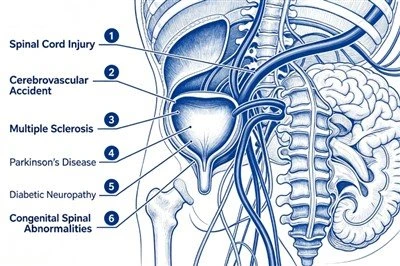

Conditions That May Be Considered for Sacral Neuromodulation
Our clinical team evaluates patients with conditions including:
- Overactive bladder (OAB)
- Urge urinary incontinence
- Non-obstructive urinary retention
- Neurogenic bladder
- Fecal incontinence
- Refractory constipation
- Interstitial cystitis
- Chronic pelvic pain
Eligibility depends on the patient's diagnosis, previous treatment history, clinical findings, and individual treatment goals. A medical record review is required before determining whether SNM is appropriate.
Two-Stage SNM Treatment Process
SNM treatment follows two main stages.
Stage 1: Test Stimulation
A temporary electrode is positioned near the sacral nerve under local anesthesia, with fluoroscopic guidance. An external stimulator delivers electrical stimulation during the trial period.
The trial typically lasts approximately two weeks. The procedure itself is generally completed in about one hour, according to our published treatment information.
Stage 2: Permanent Implantation
If test stimulation produces at least 50% symptom improvement, permanent implantation may be considered.
The implanted pulse generator is placed subcutaneously. Its stimulation settings can be adjusted by the clinical team, allowing treatment parameters to be modified over time.
Implantable Device Options
Our published treatment information describes three device configurations:
| Configuration | Battery life | Weight | Capacity | Charging |
|---|---|---|---|---|
| Basic non-rechargeable | 6–8 years | 25 g | 1850 mAh | No routine charging |
| Extended non-rechargeable | 8–11 years | 35 g | 2500 mAh | No routine charging |
| Rechargeable | 20+ years | 36 g | Not specified | Wireless charging every 2–3 months |
All three configurations are listed with stimulation parameters of 0–10 V / 0–25 mA. The appropriate option depends on the patient's clinical needs, treatment goals, and device maintenance preferences.
The published battery-life figures are manufacturer-based estimates, not guarantees of individual service life. Device selection requires clinical assessment.
Remote Sacral Neuromodulation Programming and Long-Term Follow-Up
For international patients, follow-up arrangements are an important part of treatment planning.
Our center provides remote programming support for patients after returning to their home countries. The clinical team can remotely adjust device settings, reducing the need for international travel for routine programming.
Follow-up support also includes communication regarding recovery, treatment questions, and ongoing management. The availability and technical requirements of remote programming should be confirmed for the individual device and patient's location.
International Patient Assessment
Patients considering SNM can begin with a remote medical record review.
Please submit available medical records, imaging reports, urodynamic studies, and previous treatment information. Our team will conduct a preliminary assessment to determine whether further evaluation is appropriate.
For patients requiring a second opinion, our website describes a written remote assessment service with a stated response time of 1–3 business days.
If additional examination is necessary, an in-person evaluation in China can be arranged.
Request an SNM Treatment Assessment
Submit your existing medical records for an SNM treatment assessment. Our team can review your available reports and discuss the next appropriate clinical evaluation steps.
Contact Our International Patient TeamMedical Disclaimer: This information is for educational purposes and does not constitute medical advice. SNM suitability, device selection, and treatment outcomes vary between individuals. A qualified clinician must evaluate each patient's condition before recommending treatment.
Dr. Zhang Yifei has been engaged in clinical practice for more than 30 years and he is an Associate Chief Physician in the Department of Urology. If you're going to know the cost of treatment options, welcome to contact us for pricelist and quotation.
Causes Of Neurogenic Bladder, neurogenic bladder nerve stimulator, Sacral Neuromodulation Implantation


